Operational Scalability in Global Mobility: What Readiness Looks Like
Discover how mobility teams can achieve operational scalability with structured processes and centralized data, ensuring efficiency as volume grows.


Growth and scalability are not the same. An operation grows when it handles more volume. An operation scales when handling more volume does not create proportional increases in manual coordination, errors, or dependency on specific people.
Manual processes work until they do not. A mobility team managing 50 relocations per quarter can operate through spreadsheets, email chains, and individual knowledge. At 150 relocations, that same approach creates bottlenecks. Response times stretch. Errors multiply. Critical information lives in one person's inbox. The team adds headcount to keep pace, but coordination overhead grows faster than capacity.
Scalability breaks when increasing volume forces the team to work harder instead of differently. Onboarding a new case manager takes weeks because workflows exist only in someone's head. When program directors reconcile housing status manually because no centralized system tracks confirmations. When partner coordination depends on who happens to remember the last conversation. These are not growth problems. They are structural concerns that volume exposes.
What Operational Readiness Looks Like in Global Mobility
An operation is ready to scale when processes are structured enough to handle growth consistently. That means three things: process alignment replaces individual knowledge, reliable data creates operational control, and growth does not multiply coordination.
Process alignment means teams and responsibilities follow clear, repeatable workflows instead of relying on who knows what. A new case manager can onboard a relocatee without asking five people how it works. Housing assignments follow documented steps with defined handoffs. Compliance requirements are built into the workflow, not tracked separately. When the process is the same every time, capacity is predictable.
Reliable data means centralized information and visibility make it possible to understand what is happening without manual reconciliation. Program directors see live housing status across all cohorts without asking for updates. Document collection is tracked in one place, not across email threads. Reporting pulls from a single source of truth, not spreadsheets stitched together at month-end. When data is centralized, decisions are faster and more accurate.
-
Self-assessment: Does your team lose visibility when a specific person is unavailable? Can you generate a status report for all active cases in under five minutes without asking anyone? If a case manager left tomorrow, could the next person pick up their caseload without starting from scratch? If the answer to any of these is no, the operation is not yet ready to scale.
How Global Mobility Operations Stay Scalable as Volume Grows
Scalable operations maintain consistent performance as volume increases. That consistency depends on infrastructure that absorbs growth without requiring proportional increases in manual follow-up.
Partner and owner management should remain predictable at higher volumes. Housing confirmations, lease execution, and service coordination should not require more emails per case as the program grows. When partner interactions are structured and tracked centrally, adding volume means replicating a process, not reinventing it each time. Response times stay consistent because the system handles coordination, not individuals.
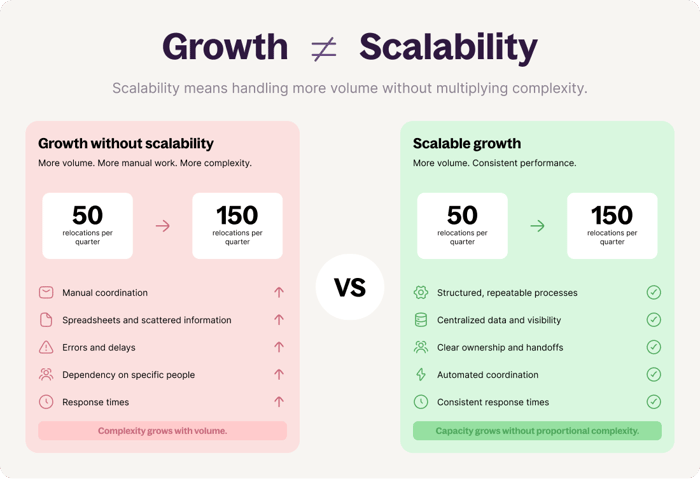
Operational maturity is visible in how the team spends time. In an unscalable operation, case managers spend most of their time chasing updates, reconciling information, and coordinating logistics. In a scalable operation, they spend time on relationships, exceptions, and problem-solving. The routine work is automated or structured. The complex work gets the attention it requires. That shift is what makes growth sustainable.
Floweal Desk is built for teams that need operational scalability before volume forces the issue. It centralizes housing, services, compliance, and participant management in one workspace. Workflows are structured. Data is live. Coordination is automated. Teams gain capacity without adding headcount proportionally to growth.
FAQs
-
What is the difference between growth and scalability in global mobility? Growth means handling more volume. Scalability means handling more volume without proportional increases in manual work, errors, or team dependency. An operation can grow without being scalable.
-
How do you know if your mobility operation is ready to scale? If increasing volume creates bottlenecks in response times, manual coordination, or dependency on specific people, the operation is not ready. Scalable operations maintain consistent performance as volume grows because processes are structured and data is centralized.
-
What infrastructure do mobility teams need to scale operations? Teams need centralized data, repeatable workflows, and automated coordination. That means one system for housing, services, compliance, and reporting. It means onboarding that does not depend on individual knowledge. It means partner management that stays predictable at higher volumes.
We make it flow.
Explore this topic