International Student Housing Miami: Manage More With Less
See how international student housing Miami teams centralize housing coordination and support more students without adding staff.


Every fall and spring semester, the same problem lands on the desk of a Miami-based international office: more incoming exchange students, the same number of staff, and a housing process that still runs on spreadsheets, email threads, and a shared inbox nobody fully owns.
Miami has become one of the most active hubs for international education in the US—Florida International University, University of Miami, Miami Dade College, and a growing number of study-abroad partner programs all bring in cohorts of students who need housing sorted before they land, not after. The volume keeps growing. The team handling it usually doesn't.
Why this breaks first at the housing step
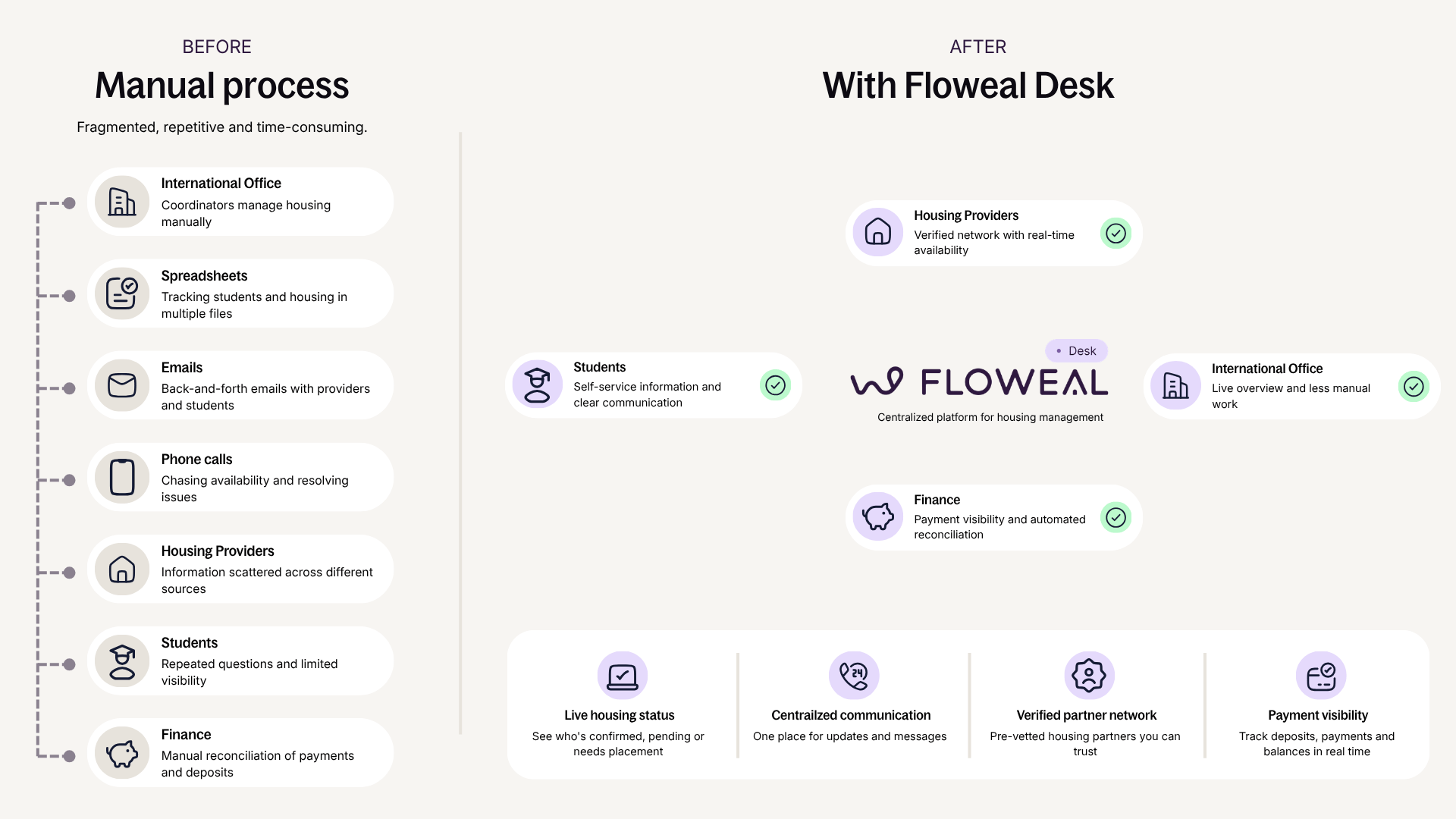
Admissions, visas, and academic advising all have dedicated systems. Housing, in most international offices, does not. It's the one part of the onboarding process still coordinated manually, which means it's also the part most likely to fail when volume spikes. A coordinator juggling housing for 40 incoming students during peak season is typically doing all the following by hand:
-
Tracking which students have confirmed housing and which haven't, often in a spreadsheet that's out of date by the time anyone looks at it.
-
Chasing landlords or property partners for availability over email, one message at a time.
-
Answering the same questions from students—what's included, how far from campus, what happens if something breaks—over and over, without a single source of truth to point them to.
-
Reconciling payments and deposits manually against whatever the finance office is tracking separately.
None of this scales linearly. Double the students, and the coordinator's workload doesn't double—it becomes unmanageable, because the coordination overhead compounds with every extra moving part.
What changes when housing runs through a single system?
The fix isn't more people. It's removing the manual coordination layer between the international office, the housing providers, and the student. That means:
-
A live view of housing status per student, not a spreadsheet someone has to update by hand. Who's confirmed, who's pending, and who still needs a placement—visible in one place instead of scattered across inboxes.
-
Housing partners connected once, not re-negotiated every semester. Instead of re-establishing relationships with landlords or housing operators every intake cycle, the international office works from a standing network that's already vetted and already integrated.
-
Students get a single point of information, not a coordinator answering the same question by email fifteen times per cohort. What's included, what the deposit terms are, and what to do if there's an issue—available directly, without routing everything through staff.
-
Finance sees what's actually happening with payments, instead of reconstructing it after the fact from separate records the housing office and the bursar's office each keep independently.
This is the difference between an international office that scales its housing operation and one that just adds a temp worker every busy season and hopes it holds.
Why this matters more in Miami specifically
Miami's rental market moves fast, and a lot of the supply relevant to students—apartments near campus, shared housing, mid-term rentals—turns over quickly. An international office relying on manual outreach to landlords is often a step behind a market that doesn't wait. A system that keeps a standing, always-current view of available housing removes that lag entirely.
There's also a duty of care dimension that's easy to underweight until something goes wrong: if a student has a housing issue at 11pm on a Friday and the only escalation path is “email the coordinator and wait until Monday,” that's a real institutional risk, not just an inconvenience. Centralizing housing status and communication means there's an actual system behind that gap, not just goodwill.
What this looks like in practice
Floweal Desk gives international offices exactly this: a single dashboard for housing status across a cohort, a standing network of vetted housing partners in Miami, and a direct channel for students to get answers without every question routing back through a coordinator's inbox. It doesn't replace your team—it removes the manual coordination that was never a good use of their time in the first place.
If your office is heading into a semester where the incoming cohort is bigger than last year's and your team isn't, that's worth a conversation before the semester starts, not after the first week of scrambling.
Frequently Asked Questions
How can a small international office manage housing for a growing number of incoming students? By centralizing housing status, partner availability, and student communication in one system instead of coordinating each placement manually by email and spreadsheet, this is what removes the need to add headcount every time a cohort grows.
Does using a platform like Floweal Desk replace our international office staff? No. It removes the manual coordination work—chasing availability, updating spreadsheets, answering repeat questions—so your existing team can focus on advising and exceptions instead of logistics.
What's the real cost of not centralizing housing coordination? Beyond staff time, the biggest cost is risk: delayed placements, inconsistent information given to students, and a duty-of-care gap if an issue can't be escalated quickly outside business hours.
We make it flow.
EXPLORE RELATED TOPICS