Renting an Apartment in NYC Guide: Fees and Guarantors
This renting an apartment in NYC guide covers broker fees, guarantors, credit checks, and the 2025 changes newcomers need to know.


New York's rental market runs on conventions that don't exist almost anywhere else, and if you're arriving from another country—or even another US city—some of what you'll be asked for will look like a mistake. It isn't. Here's what's actually normal, what recently changed, and what to watch for.
The broker fee situation just changed—know which rules apply
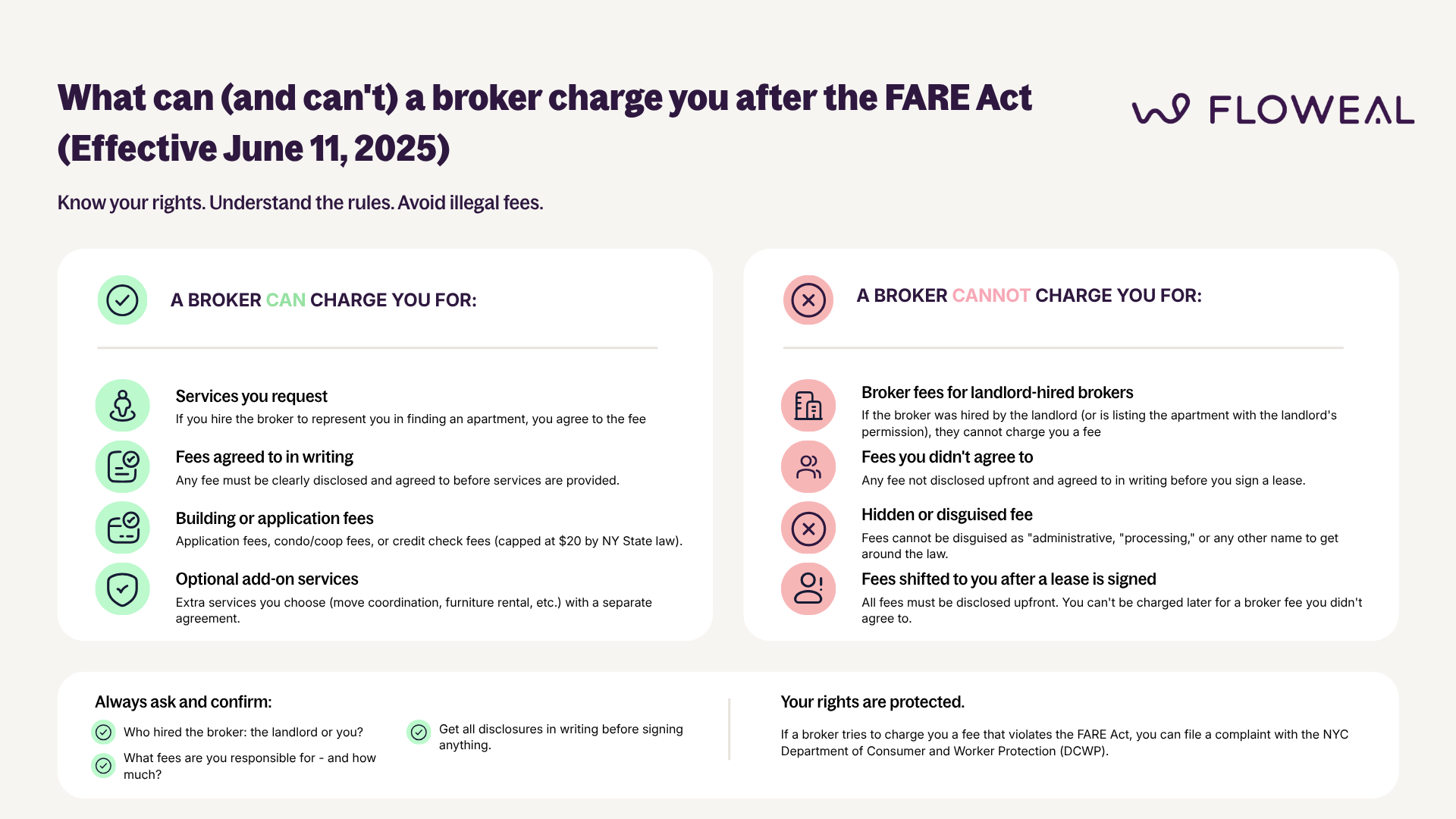
For decades, it was common in New York for a landlord to hire a broker to list an apartment and then pass that broker's fee—often a full month's rent or up to 12–15% of the annual rent—onto the tenant, even if the tenant never asked for the broker's help. That changed with the FARE Act (Fairness in Apartment Rental Expenses Act), which took effect June 11, 2025. Under this law:
-
If a landlord hires a broker—including one who lists the apartment with the landlord's permission—that broker cannot charge the tenant a fee.
-
The landlord is liable if their listing agent violates this, even if the landlord never dealt with the tenant directly.
-
Tenants can still choose to hire their broker to help with the search, and if they do, they pay that broker directly. The distinction is who initiated the relationship.
-
Listings must disclose all fees a tenant will actually owe, upfront, before a lease is signed.
Practically: if a broker tries to charge you a fee for an apartment they listed on a landlord's behalf, that's very likely no longer legal. If you're unsure whether a broker is representing the landlord or working for you, ask directly before agreeing to anything.
The guarantor requirement—this one still exists
New York landlords, especially for buildings without doorman-level amenities, commonly require tenants to show income around 40x the monthly rent. Without a US income or credit history, most newcomers won't meet that threshold on paper, even with a solid job offer.
The standard workaround is a guarantor—someone (often required to earn significantly more than the tenant, sometimes 80x monthly rent) who co-signs and is on the hook if rent goes unpaid. If you don't have someone in the US who can act as a guarantor, several services exist that act as a paid guarantor on your behalf, typically for a fee equal to roughly one month's rent. This is worth knowing before you fall in love with an apartment you can't otherwise qualify for.
What's capped, and what isn't
New York State law gives you more predictability than a state like Florida in a few specific places:
-
Security deposit: capped at one month's rent.
-
Credit and background check fees: capped at $20 total, and the landlord must give you a copy of the report.
-
Broker fees: no longer chargeable to you if the broker was hired by the landlord (see above).
What isn't capped: the rent itself, in most of the city (rent stabilization applies only to specific buildings, generally older ones—it is not a citywide protection, and you should not assume an apartment is rent-stabilized without checking).
Watch for workarounds
Since the FARE Act took effect, some listings have tried creative ways around it—bundling a broker fee into a higher advertised rent, for example, or calling it something besides a broker fee. If a fee shows up that doesn't map cleanly to rent, deposit, or a guarantor service you actually asked for, ask exactly what it's for and whether it's tied to a broker you didn't hire. You can also file a complaint with the city's Department of Consumer and Worker Protection if something looks like a workaround.
Before you sign anything
Confirm in writing the exact fees you're responsible for and to whom, the deposit amount, whether the unit is rent-stabilized, what the guarantor requirement is if you don't qualify on income alone, and the lease renewal terms. None of this should be a verbal promise from an agent—it needs to be in the lease or in a written disclosure.
Floweal Go is built for exactly this gap: apartments with terms disclosed upfront, documentation you can actually understand before you commit, and no guessing about which fees are legitimate and which are a workaround someone's trying on a newcomer who doesn't yet know the rules.
Frequently Asked Questions
-
Can a broker still charge me a fee to rent an apartment in NYC?
Only if you hired that broker yourself. Since the FARE Act took effect on June 11, 2025, a broker hired by the landlord can no longer charge the tenant. -
What is a guarantor, and do I need one?
A guarantor co-signs your lease and is financially responsible if you can't pay rent. You'll typically need one if your income doesn't meet the standard 40x-monthly-rent threshold most NYC landlords require—common for newcomers without US income history. -
How do I know if my apartment is rent-stabilized?
Don't assume it is—rent stabilization applies only to specific, generally older buildings, not citywide. Ask the landlord directly and get it confirmed in writing before signing.
We make it flow.
EXPLORE RELATED TOPICS